
Neighborhoods of Northfield - Historic Downtown
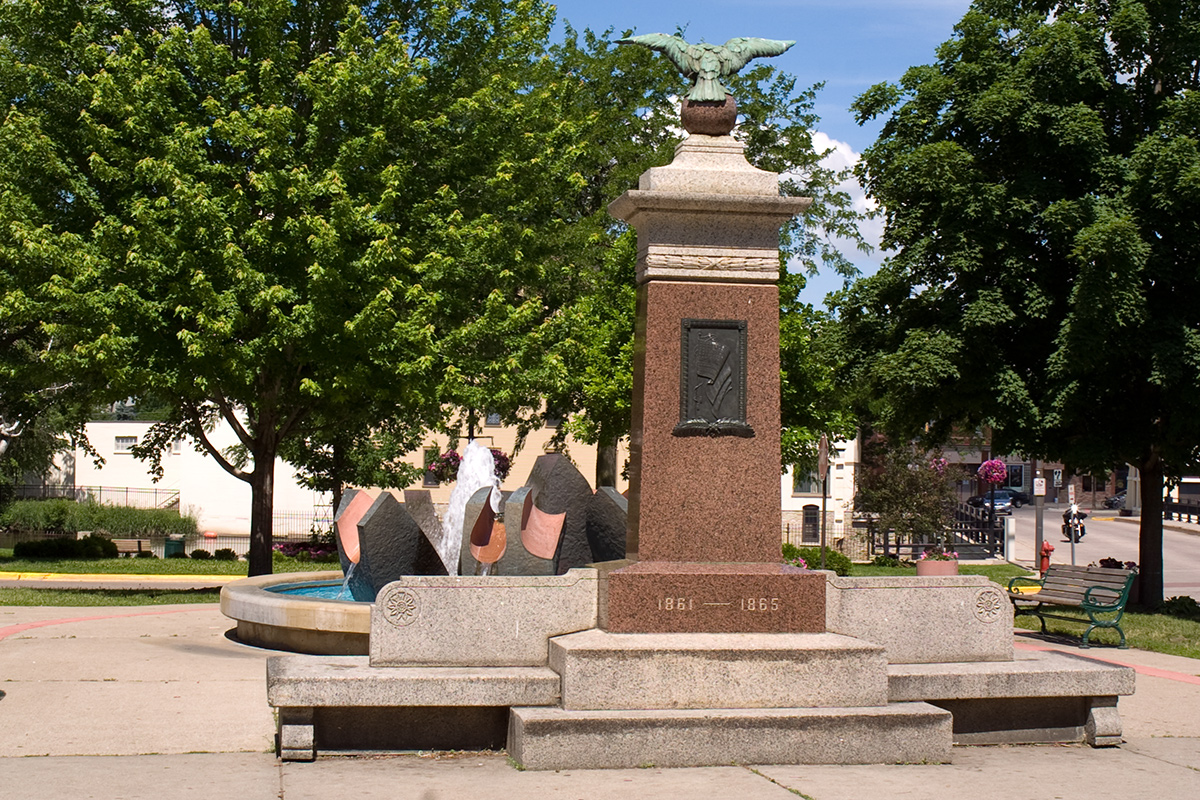
The water spray from the Sheldahl Anniversary Fountain in Bridge Square looks inviting on this warm spring day. I find a seat on a bench in the square to admire the view while enjoying an ice cream cone from nearby Hogan Brothers. The eagle atop the Civil War Monument looks particularly majestic and the hanging baskets add a touch of color next to the green of the shade trees. I close my eyes and listen to the background sounds of the Cannon River spilling over the Ames Mill Dam next to the Square. After I finish my cone, I pull out my brochure Northfield Historic Sites and Points of Interest and decide to explore Northfield’s Commercial Neighborhood, Historic Downtown.
The sixty-five buildings that make up the Commercial District of Northfield were preserved as an Historic Neighborhood in 1978 in order to maintain a connection to the past. The stone and brick buildings tell a story of survival in early pioneering days when fire easily changed the landscape of prairie towns. Most of these buildings were built before 1895 with the purpose of creating structures of quality that would endure and provide a center where families would grow and thrive. They were placed close together for easy accessibility, like walking today.
Bridge Square makes a good starting point. According to the brochure, “Northfield began at Bridge Square.” John W. North built a saw mill on the West Side to process lumber for construction and a grist mill on the East Side to process grain into flour. The nearby land at the corner, bordered by businesses and the Cannon River, became known as “Mill Square” due to its proximity to the mills. As it was used by community members to water and park their horses when attending the local “woodmarket” or trading goods, the square also became known as “Horsecollar Park.” From the beginning of Northfield’s founding, the open space now known as Bridge Square has offered a place for the community to meet, host market fairs, or celebrate the arts and holidays.
I walk the downtown perimeter stopping at the nearby Scrivner Building (1868), the oldest limestone building in town. This once housed the bank that the James-Younger Gang planned to rob in 1876, which proved unsuccessful. Some places like the All Saints Episcopal Church at 500 Washington Street (1866) have a history of praying for the souls of such visitors to Northfield. The McClaughery Block (1882) on the corner of Division and Fifth Street is the second-largest structure in the district with a well-preserved upper story. The largest building in town is the Central Block Building (1893) which sits on the corner of Division and Fourth Street; it is designed in a Queen Anne style, Romanesque mode.
John North as well as other members of the community wanted the world to know that, even in the pioneer town of Northfield, Minnesota, culture and learning flourished. Ephraim Lockwood built an opera house in 1872 which is next to the McClaughery Block. Just a block over on Fourth Street John North built the Lyceum Building (1857), the oldest building in Northfield, for meetings, debates and lectures. By the end of the century, A.K. Ware built the Ware Auditorium to showcase opera and theatrical performances, concerts, and traveling shows.
Each building in Historic Downtown has distinctive architectural styles or elements that make them notable. Some mimick Italian farmhouse villas or Prairie style architecture, some blend Queen Anne and Romanesque Revival styles. I have meandered through Victorian Downtown for quite a while now and I need a break. I find the perfect place at 319 Division Street, the Clark Building (1925). Built with minimal details from a functional architect’s vision, popular in the 1920s, the building is now home to Goodbye Blue Monday Coffeehouse. While sipping on a great cup of coffee, I find the Northfield History Center online which rounds out the information in the brochure with a virtual tour for fifty-three of the buildings in text, audio and video formats. The Digital Division Project tells the stories the brochure begins.
I am sure I did not visit all sixty-five buildings but I have made a good start. Next time I shop downtown, I will look for those QR codes the Digital Division Project placed on historical structures and learn a little more about Northfield’s Commercial Neighborhood, Historic Downtown.